Some mornings begin with one missing sock, a half-eaten banana, and a little person who suddenly cannot bear the thought of wearing shoes. You can have the bags packed the night before and still find yourself saying, “Come on, we’re late,” a dozen times. Often, the difficult part isn’t any one task. It’s getting from one thing to the next.
A visual morning routine chart for toddlers gives those transitions a place to land. Instead of keeping the whole plan in your head and announcing every instruction, you put a short sequence of pictures where your child can see it. The chart won’t prevent every hard morning. It can make the next step feel more predictable—and give you something calmer to point to when words aren’t helping.
At a glance: Start with four to six pictures in the order your family actually gets ready: wake up, bathroom, get dressed, eat breakfast, brush teeth, and shoes or bag. For a younger toddler, use only two or three pictures. Put the chart at your child’s eye level, point to one step at a time, and help with any task they cannot yet do alone.
A six-step visual morning routine for ages 2–5
Try this example as a starting point. Rearrange the steps to fit your family’s habits. There is no special benefit to putting getting dressed before breakfast if your child usually eats first.
| Picture to use | Child-friendly label | What you can say |
|---|---|---|
| Sun or curtains | Wake up | Good morning. Let’s open the curtains. |
| Bathroom or diaper | Bathroom | Bathroom first; then we’ll get dressed. |
| Shirt and pants | Get dressed | Would you like the blue shirt or the green one? |
| Bowl and spoon | Breakfast | Let’s sit together for breakfast. |
| Toothbrush | Brush teeth | First teeth, then shoes. |
| Shoes or backpack | Ready to go | Shoes on. Let’s check your bag. |
The chart is not a contract. Some days, your child may be hungry before they are ready to get dressed. On another morning, a hug needs to come before the bathroom. Keep the overall sequence familiar while leaving space for real people and real needs.
How to make your own picture chart in 15 minutes
1. Watch an ordinary morning before drawing anything
Notice the sequence you already use. Which steps happen easily? Where does everything stall? If getting dressed takes ten minutes rather than three, build that into your plan. The best chart reflects the morning you have—not the one you wish you had.
2. Choose photos your child can recognize
A photo of your child’s actual shoes may be clearer than a decorative shoe icon. You can use simple drawings, cut-outs, or photos of household objects. Keep just one action per image. If your child isn’t reading yet, picture clarity matters more than tiny printed labels.
3. Start with three steps if six feel overwhelming
For younger toddlers, try get dressed → breakfast → shoes. A three-step strip can be less demanding than a colorful poster with twelve different activities. Add more pictures only when your child seems comfortable following the first few.
4. Place the chart where the routine happens
Tape it at your child’s eye level near the bedroom door, bathroom, or kitchen. If you want an interactive version, let your preschooler move a card into a “done” pocket. Skip the extra materials if they create more work than help.
5. Practice on a calm afternoon
Look at the pictures together when no one is late. Point to each one and say what it means. Try: “This is the toothbrush. After teeth, we look at the shoes picture.” Thirty seconds of relaxed practice can be more helpful than a long morning lecture.
6. Point, wait, and help
When breakfast ends, ask, “What comes next?” and pause. If your child looks lost, show the picture and help them start. A toddler learning to fasten shoes still needs you. The chart is a memory aid, not a demand for independence before they are ready.
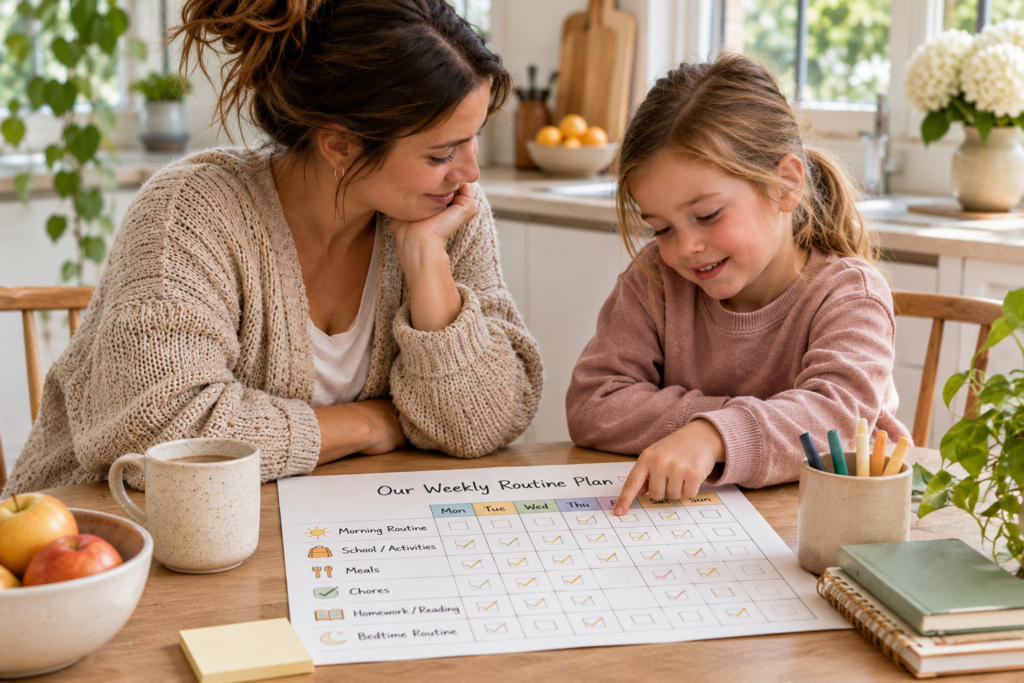
An example morning schedule without the rush
If you need to leave by 7:40 a.m., you might work backward like this. Treat the times as an example, not a standard that every toddler should meet:
- 7:00–7:05: Wake up, cuddle, and head to the bathroom.
- 7:05–7:15: Toilet or diaper and clothes, with help as needed.
- 7:15–7:30: Breakfast, including time to finish without rushing.
- 7:30–7:35: Brush teeth and wash hands.
- 7:35–7:40: Shoes, coat, bag, and out the door.
If your toddler needs longer to eat, starts slowly, or is sharing the routine with a sibling, add a buffer. Some families need an hour; others need much less. The schedule is useful only if it helps you notice where a little extra time would make mornings gentler.
What to say when your toddler refuses a step
Pictures show the plan, but they can’t erase tiredness, frustration, or a child’s wish to keep playing. When resistance starts, use fewer words, acknowledge the feeling, and offer a manageable next step.
- “No clothes!” — “You don’t want to get dressed yet. Clothes are next. Blue shirt or green shirt?”
- “I want to keep playing!” — “You wish there were more playtime. One last turn, then shoes. I’ll help.”
- “I hate the chart!” — “It’s here to help us remember, not to boss you around. We can do this part together.”
- When you’re already late: — “Today is a helping morning. I’ll do the buttons; you can carry your shoes.”
The CDC’s guidance for giving directions to toddlers and preschoolers recommends giving one direction at a time, using clear language, and matching directions to a child’s abilities. An extra gesture or picture can be a useful visual cue.
Troubleshooting: when the chart isn’t helping
The chart has too many pictures
Remove a few. Start with the two or three steps most likely to make the morning easier. You can keep the full checklist for yourself.
Your child ignores the pictures
Check whether the images are recognizable and the chart is easy to see. Try photos of familiar objects and invite your child to point to the next step with you. The first goal is participation, not independent completion.
Everything goes wrong at the same step
Look for an unmet need or a difficult transition. Is breakfast too late? Is your child sensitive to scratchy clothing? Does moving from play to shoes feel abrupt? Fixing that bottleneck matters more than making the chart prettier.
The chart turns into a reward battle
You don’t have to pay for every completed picture with a sticker. Some families enjoy moving a card to “done,” and that can be enough. Praise a specific effort—“You checked what comes next”—rather than turning the morning into a performance.
Your child needs more support than peers
Children differ in language, sensory preferences, motor skills, and how they handle transitions. Adapt the visuals, timing, and amount of adult assistance. If daily routines are consistently unusually distressing or you have concerns about development, discuss them with your child’s pediatrician rather than treating a chart as a cure.
How to use the chart for a child who isn’t reading yet
Use actual photos and a predictable left-to-right or top-to-bottom order. Point to the picture while saying the words aloud. Keep the chart visible rather than expecting your toddler to remember every step. Children who benefit from extra visual support may prefer detachable pictures, a “first/then” strip, or a simple photo card for each transition.
For example, try a two-card strip: First: toothbrush. Then: shoes. Once that feels familiar, add the next step. A visual cue is helpful when it makes an instruction simpler, not when it adds another task to complete.
Make the routine work for two caregivers
Consistency doesn’t mean everyone must say the same sentence. Agree on the order of the main tasks and keep the chart in the same place. One caregiver can offer a choice of clothing while the other helps with shoes. If the sequence changes on weekends, make a second, shorter version rather than pretending Saturday looks like Monday.
If morning routines regularly differ between homes, make a basic chart with only the steps that happen in both settings. Talk through the differences without blaming either caregiver. You can also read our guide to routines that work for one parent but not the other.
Free routine charts and what to read next
You don’t need to design a chart from scratch. Visit the Simplee Parenting routine chart collection and choose a format you can adapt. For a fuller school-day plan, read our morning routine guide for kids. If you’re dealing with a child who becomes upset at transitions, the big feelings guide has ideas for supporting emotions without giving up clear boundaries.
There is also a separate guide on building a toddler morning routine. This article focuses specifically on creating and using the visual chart, while that guide covers the broader daily rhythm.
Common questions about toddler visual morning routines
What age should a toddler start using a visual schedule?
You can introduce a very simple picture sequence whenever your child begins to recognize familiar actions, but the amount of support will differ. For many two-year-olds, two or three large pictures may be plenty. Preschoolers may enjoy a longer six-step chart and moving finished cards themselves.
Should I use a reward chart or a routine chart?
A routine chart primarily answers, “What comes next?” A reward chart tracks behavior or achievements. For stressful mornings, start with a sequence chart so your child understands the plan before adding any reward system.
How long does it take for a new morning routine to work?
There’s no reliable universal number of days. Watch for small signs of progress: fewer repeated instructions, a child pointing to the next picture, or one transition becoming easier. Change the chart if it doesn’t fit the family’s needs.
What if my toddler refuses to brush their teeth?
Keep toothbrushing in the routine, but treat the refusal as a separate challenge. Offer a simple choice, model the task, and provide age-appropriate help. The chart can show what comes next; it doesn’t replace supervision or appropriate dental care.
Can I use the same chart on weekends?
Yes, if the sequence is similar. If weekends involve a much slower morning, use a shorter weekend chart with the essential steps. The idea is predictable order—not the same clock time every day.
Sources and editorial note
This guide is practical parenting information, not individualized developmental or medical advice. Its examples are adaptable rather than rules every family must follow. Background guidance: CDC: Routines and rules for toddlers; CDC: Steps for giving good directions. The six-step chart and parent scripts are original illustrative examples prepared for Simplee Parenting.