Key Points
- Parallel play is a normal bridge toward cooperative play, not a sign that your toddler cannot make friends
- Sharing develops slowly because waiting, flexibility, and language are still growing
- Short guided games help toddlers practise turn taking without pressure
- Adults can model simple words and protect children while they learn to solve small conflicts
- Children develop at different rates, so look for progress in connection and recovery rather than perfect sharing
Watching toddlers play side by side can be confusing. One child reaches for a truck, another pulls it back, and suddenly both are crying. You may wonder why your toddler will happily play near another child but struggles to share or join the same game. This is a normal part of early social development. Cooperative play grows gradually as children learn language, flexible thinking, turn taking, and the ability to notice another person’s idea.
Cooperative play does not arrive because a child hears a lecture about being nice. It develops through repeated, supported experiences that are short enough to feel safe. Your role is to create chances to practise, keep bodies safe, and give your toddler words for what is happening. This guide explains the stages of play and practical ways to help without forcing friendship or demanding adult level sharing.

What Is Cooperative Play?
Cooperative play happens when children play together with some shared purpose. They may build a tower, pretend to run a shop, make a road for cars, or create a simple game with rules. The children do not need to agree every second. They are learning to notice one another, communicate an idea, adjust a plan, and stay connected through small disagreements.
A toddler can be interested in another child and still prefer a separate toy. Interest is not the same as readiness for a shared project. When adults expect too much too soon, the pressure can turn a promising moment into a struggle. Start with shared attention, then build toward shared action.
The Developmental Stages Before Cooperative Play
Children move through stages at different speeds. The stages overlap, and a child may move back to simpler play when tired, sick, or overwhelmed. Understanding the sequence helps you choose an expectation that fits your toddler today.
Solitary Play
In solitary play, a child explores alone. This is valuable learning, not social failure. Toddlers practise movement, cause and effect, and problem solving while an adult stays nearby. Protecting some uninterrupted solo play can actually give your child the security needed to explore later with others.
Parallel Play
During parallel play, children use similar materials near one another without a shared plan. They may copy a sound, glance at a block tower, or take the same kind of toy. This is often the first bridge toward cooperative play. Stay close and describe the connection without demanding that the children combine their toys.
Associative Play
Associative play includes more direct contact, such as trading crayons, looking at another child’s puzzle, or talking about a pretend animal. The children may use the same materials but still follow separate ideas. Adults can support this stage by offering duplicate toys and simple words for joining.
Cooperative Play
Cooperative play becomes more organised as children can hold a shared idea for longer. A preschooler may be ready to assign roles in pretend play, while a younger toddler may manage only a few connected turns. Both are meaningful progress. The goal is not to make the interaction last a particular number of minutes.
Why Toddlers Struggle to Share
Sharing asks for impulse control and an understanding that another person has a separate wish. Those skills are still under construction in toddlerhood. A child may know the words “my turn” but be unable to wait when the desired toy is right in front of them.
Ownership Feels Immediate
Young children often experience possession as a strong present moment feeling. Taking a toy away can feel like losing something important, even when the toy belongs to the group. Instead of arguing about whether your toddler is being selfish, help them move through the feeling and practise a short turn.
Language Is Still Catching Up
A toddler who cannot say “Can I have it when you finish?” may grab. Teach one short phrase and repeat it often. Cooperative play becomes easier when a child has a way to enter an activity, ask for help, and say stop.
Busy Settings Add Pressure
Playgroups, daycare rooms, and birthday parties include noise, movement, and unexpected changes. A child who manages a two person game at home may struggle in a larger group. Begin practice in a calm setting and shorten the activity when your child’s body shows signs of overload.
Seven Ways to Support Cooperative Play
1. Begin With a Shared Interest
Notice what both children already enjoy. If they are pushing cars, place a road mat between them. If they are feeding dolls, add a small bowl. Joining an existing interest is easier than announcing a completely new group activity.
2. Use Duplicate Toys at First
Two similar trucks or two sets of blocks reduce unnecessary conflict while children learn to stay near one another. Duplicate materials do not prevent sharing. They create enough calm for children to notice each other before they practise exchanging.
3. Model the Words You Want to Hear
Keep phrases short: “Can I have a turn?” “You can have it after me.” “Help, please.” Say the words while gently guiding the action. Do not expect a toddler to remember a long script during a difficult moment.
4. Use a Short Turn Taking Game
Roll a ball back and forth, add one block each to a tower, or take turns placing animals in a barn. Use a visual cue such as a small timer only when it helps. End while the game is still going well, so your child remembers success rather than an exhausting conflict.
5. Narrate Without Taking Over
Describe what you see: “You both want the red cup. Maya is holding it. You are waiting beside her.” Neutral narration gives children information without deciding who is good or bad. Step in firmly when a child is hurt, but allow small safe pauses for children to try their words.
6. Create a Calm Exit
Some interactions have reached their limit. Offer a simple choice such as moving to play dough or looking at books. A calm exit is not a punishment. It protects the relationship and gives the nervous system time to settle before the next opportunity.
7. Notice Effort Rather Than Perfect Sharing
Say, “You gave the block back when I reminded you,” or “You waited while your friend finished.” Specific feedback helps your toddler understand what worked. Avoid broad labels such as generous or selfish, because children need information about an action they can repeat.
How to Handle Toy Conflicts
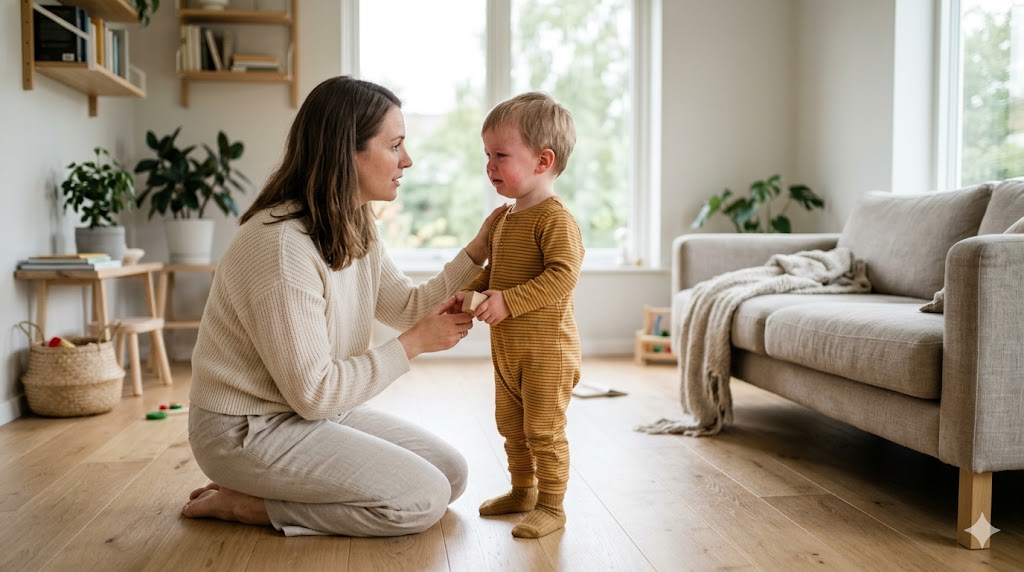
Move close, block unsafe hands, and use a calm limit: “I will not let you hit. The truck is being used.” Acknowledge both wishes without promising that every child gets the toy immediately. If a child is finished, help them pass it. If not, offer another activity or a short wait with adult support.
Do not force an apology while a child is crying or still grabbing. First help the body calm. Later, your toddler can repair with a simple action such as bringing a tissue, rebuilding a tower, or practising the words. Repair teaches responsibility without humiliation.
Practice Ideas for Home and Playdates
- Build one tower together, with each person adding one block.
- Take turns choosing a song or animal sound.
- Use pretend cooking to practise offering, waiting, and asking.
- Play a simple matching game with only a few pieces.
- Invite one familiar child for a short playdate before a large gathering.
- Keep a favourite comfort activity available when the play becomes too intense.
When to Get Extra Guidance
Consider speaking with your child’s healthcare professional if your toddler rarely shows interest in people, loses skills they previously had, cannot recover from ordinary social moments, or regularly causes serious injury despite close adult support. A developmental concern is not a diagnosis from one difficult playdate. Early guidance can help you understand your child and choose practical support.
Frequently Asked Questions
At what age does cooperative play begin?
There is no single starting age. Toddlers often move from solitary and parallel play toward more connected play during the preschool years. The timing depends on language, temperament, experience, and the setting.
Should I make my toddler share?
Teach turn taking and keep everyone safe, but avoid demanding that your toddler hand over a treasured object immediately. Offer language, a timer when useful, and a clear plan for when the turn changes.
Why does my toddler play well at home but not at daycare?
Home is usually quieter and more predictable. Daycare adds group noise, transitions, and many competing wishes. Ask the caregiver what happens before the conflict and practise one familiar phrase across both settings.
Is parallel play a problem?
No. Parallel play is an important bridge. Children can learn social awareness while playing beside one another, even when they are not yet sharing a storyline or taking equal turns.
Building cooperative play
Cooperative play grows through short games, turn taking, and adult coaching that helps toddlers repair small conflicts. Keeping cooperative play practical and repeatable helps the whole family.
For broader, evidence informed context, see AAP toddler guidance.
Related Guides
Toddlers 1 to 3 Years | Big Feelings | Positive Discipline | Calm Down Strategies for Toddlers | Learning Through Play
Sources and Editorial Note
This article is educational information for parents and is not medical advice. The developmental guidance was reviewed against resources from ZERO TO THREE, the National Association for the Education of Young Children, and the Centers for Disease Control and Prevention. Families should seek individualized advice when developmental concerns persist or safety is involved. Reviewed by the Simplee Parenting editorial team.
Want more peaceful play?
Explore simple tools for big feelings, toddler behavior, and everyday routines.