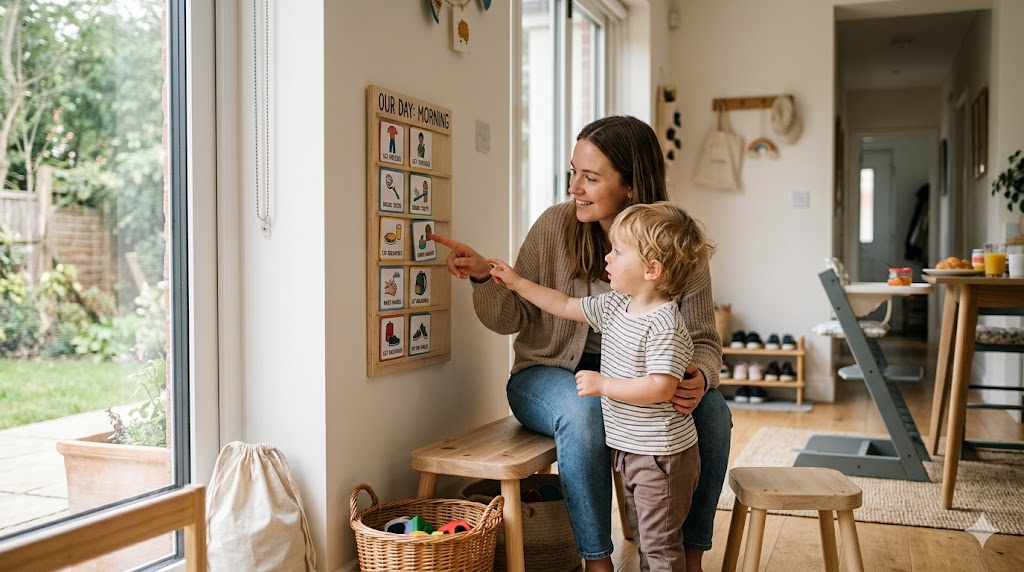
Routine charts give children a clear picture of what happens next. Instead of repeating the same instructions throughout the day, you can point to one simple sequence and help your child move through it with more confidence. The chart is not a test and it does not need to be perfect. It is a gentle visual reminder that makes everyday transitions easier for the whole family.
At a glance
These free routine charts are designed for young children who benefit from short, visual steps. Start with one routine, keep the order predictable, and adjust the wording or pictures to fit your home.
Download the Free Routine Charts
Choose a chart below and print it at home. These free routine charts for children are original, one page PDFs, and no email is required. They work well for toddlers and preschoolers, and you can print them on A4 or Letter paper using “fit to page.”
- Download the Morning Routine Chart (PDF) — a simple sequence for getting ready with less rushing.
- Download the Bedtime Routine Chart (PDF) — a calm visual reminder for the evening wind down.
- Download the After School Reset Chart (PDF) — a short reset for belongings, snack, rest, and play.
For best results: place the chart at your child’s eye level, review the steps together, and let your child check off each task.
Why Routine Charts Help Children
Young children often know what adults are asking but lose track when several instructions arrive at once. A visual routine breaks a larger task into small, visible steps. This supports independence, reduces repeated reminders, and gives children something concrete to check when they feel unsure. It can also make transitions feel less sudden because the child can see where the routine begins and what comes next.
Which Charts Are Included
Morning routine chart
The morning sequence can include waking up, using the bathroom, getting dressed, eating breakfast, brushing teeth, and putting on shoes. Choose only the steps your child can reasonably complete at this age. If the morning is rushed, place the chart where your child gets dressed so it is easy to follow without leaving the room.
Bedtime routine chart
A bedtime chart may include tidying toys, putting on pajamas, brushing teeth, choosing a book, and getting into bed. Keep the order the same most nights. Predictability helps children prepare for sleep and makes it easier for parents to hold a calm boundary when the routine is finished.
After school and daily reset chart
For older toddlers and young school age children, an after school chart can show where to put belongings, wash hands, have a snack, rest, and begin homework or play. A short reset sequence can prevent the tired period after school from turning into a long series of arguments.
How to Use a Routine Chart Effectively
- Introduce the chart during a calm moment, not in the middle of a difficult transition.
- Walk through every picture or step together and demonstrate what each one means.
- Place the chart at your child’s eye level in the room where the routine happens.
- Point to the next step before repeating verbal instructions.
- Praise effort and progress rather than speed or perfect completion.
- Review the chart after a week and remove steps that are no longer useful.
Adjusting the Chart for Different Ages
Children under three usually do best with a few large pictures and very little text. Preschoolers can follow five or six short steps and may enjoy moving a marker after each task. School age children can use a longer checklist and help decide which steps belong on it. If your child has sensory, language, attention, or motor differences, simplify the sequence and adapt the format rather than treating difficulty as refusal.
Common Mistakes to Avoid
A routine chart works best when it supports the parent child relationship instead of replacing it. Avoid adding every small task, changing the order every day, or using the chart as a threat. Do not expect a child to become independent immediately. Model the routine, offer help when needed, and gradually step back as the sequence becomes familiar.
Frequently Asked Questions
What age can a child start using a routine chart?
Many children can begin with two or three picture steps around 18 months, while others need more time. Start when your child shows interest in copying routines and keep the first chart very short.
What should I do if my child ignores the chart?
Reduce the number of steps, move the chart closer to the action, and practice when everyone is calm. Use a brief prompt such as “What comes next?” and point to the picture instead of repeating a long explanation.
Should the chart change on weekends?
The order can stay familiar while the timing changes. Keep the first and last parts of the routine consistent, then add a small weekend variation if it helps your family.
Related Parenting Resources
Explore the Parenting Resources library, browse the free parenting printables, or continue with our morning routine guide and bedtime routine guide.
For general positive parenting guidance, see HealthyChildren.org’s routines guidance from the American Academy of Pediatrics.
These charts are educational tools, not medical advice. Adapt them to your child’s needs and speak with a qualified professional if you have concerns about development or daily functioning.